
Lancashire County Council makes High Court bid and referendum call after government stays silent on reorganisation decision
The authority wants to ensure it does not lose its right to legally contest the government’s planned shake-up of local councils.
Lancashire County Council has made a legal move to ensure the door remains open for it to formally challenge a controversial local authority shake-up - after ministers refused to answer a key question about the process.
County Hall has lodged a so-called ‘protective claim’ in relation to the government’s plans to axe all 15 of Lancashire’s main local authorities and create four new ‘super councils’ in their place.
The authority’s cabinet provisionally agreed earlier this month to take the step - if the government failed to provide the requested information by a deadline that threatened to cut off the county’s right to launch a judicial review of the overhaul.
The Ministry of Housing, Communities and Local Government (MHCLG) ultimately failed to respond in time - and so the county council began proceedings at the High Court of Justice Administrative Court last week, the Lancaster Guardian can reveal. It is seeking to extend the time period within which a court challenge can be brought.
Separately, the Reform UK-run authority also voted to call for a legally-binding referendum on any changes before they are implemented - a request ministers have previously denied.
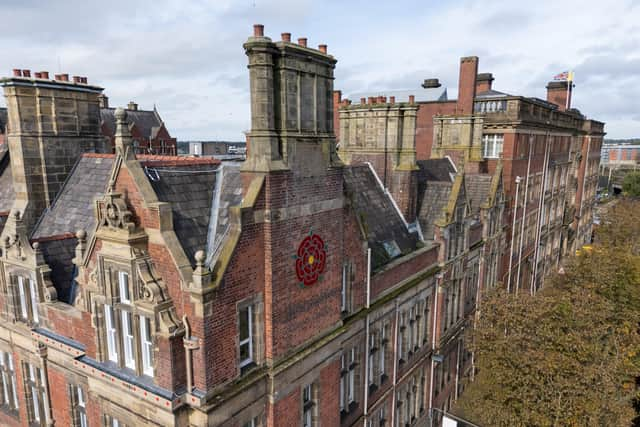

The government announced in July that it was minded to carve Lancashire into four new council areas from April 2028. The decision marked what then appeared to be the denouement of a streamlining project known as local government reorganisation (LGR).
Lancashire’s existing local authorities had been asked to come up with proposals for the number and geographical shape of the handful councils that would replace them. They put forward possible configurations for two, three and five new councils, along with two versions of a four-way split.
One of the four-council options - which was the most widely-backed of the suggestions - was selected by the government, dividing the county into new authorities for North Lancashire (based on the current Preston, Lancaster and Ribble Valley footprints), South Lancashire (Chorley, South Ribble and West Lancashire), East Lancashire (Blackburn with Darwen, Burnley, Hyndburn, Rossendale and Pendle) and the Fylde Coast (Blackpool, Fylde and Wyre).
However, in an unexpected announcement early last month, local government secretary Angela Rayner told the Commons that LGR - which is also being undertaken in almost two dozen other counties across England - was being put on hold for a “review” to ensure the actions taken to date were legally compliant.
Although the ruling Reform group had been opposed in principle to the revamp, Lancashire County Council had nevertheless answered the government’s call for recommendations about how the local authority map should be redrawn. It suggested a north-south split, with the county divided into two council areas - one incorporating Preston, Blackpool, Fylde, Wyre, Lancaster and Ribble Valley and the other encompassing Blackburn with Darwen, Chorley, South Ribble, West Lancashire, Burnley, Hyndburn, Rossendale and Pendle.
Since the government’s preference was announced, County Hall has been seeking details about the evidence on which the choice was made, in order to decide whether to challenge it via a judicial review.
Ministers have refused to provide the full rationale for choosing the four-way configuration, but the county council - and all of the authorities whose suggestions were unsuccessful - had three months within which they could launch a legal action contesting the process that had been followed.
However, a question mark was placed over that timetable by the abrupt halt called to the proceedings last month, which seems set to push the revamp back by at least a year.
It was unclear whether the clock for a judicial review application had stopped ticking when the government's own legal check was announced - and the government did not answer repeated requests from the county council for clarification.
If the government’s pause amounts to a full reassessment of all five options and the issuing of a fresh decision, the three-month window to challenge it will start from the point the new announcement is made.
However, if ministers were to declare they were standing by their July decision - without having gone back to the drawing board to formally issue it anew - the opportunity to mount a judicial review would have expired on 16th October.
In the absence of an answer to that crucial question, the county council last week took the action - previously authorised by cabinet members - and issued a pre-emptive claim for what is known as a ‘stay’ to the three-month time limit for a legal challenge.
Should that be granted, County Hall will retain the option to seek a judicial review regardless of the government’s definition of its pause.
The five proposals that Lancashire's existing councils put forward totalled more than 800 pages of supporting evidence, including financial forecasts and practical implications for each of the suggested configurations. However, the government's reasoning for the option it ultimately chose was set out in a letter spanning just four-and-a-half pages - and the county council has been pushing for a fuller explanation.
The Post approached the MHCLG for comment on Lancashire County Council’s protective claim, but had not received a response by the time of publication.
Referendum call renewed
Within weeks of Reform UK taking control of Lancashire County Council after the local elections in May 2025, the authority’s new leader, Stephen Atkinson, asked local government minister Jim McMahon for permission to hold a legally-binding referendum on LGR.
Such a vote would effectively give Lancashire residents a veto over the changes, which, once implemented, will end the current two-tier system under which responsibility for services is split between the county council and Lancashire’s dozen district authorities. The replacement councils would be ‘unitary’ bodies, responsible for all services in their patch - as is already the case for Blackpool and Blackburn with Darwen councils.
However, while Mr. McMahon said Lancashire was free to stage any poll it wanted on the subject, he refused to commit the government to adhering to the outcome - stating that it was “is not part of the statutory process which has already begun”.
Nevertheless, nearly 18 months on - and against the backdrop of the uncertainty now hanging over the LGR process - the call for a referendum was put back on the table at a county council meeting last week.
Bringing a notice of motion to ask the government once again for a legally-binding vote, cabinet member for health and wellbeing Daniel Matchett lamented the “uncertainty” brought about by the proposed changes.
“Reorganisation has become the reason to put things off - decisions get parked and long-term planning stalls,” he said.
“Every new council then needs to have its own…director of adult social services and its own director of public health. And…the computer systems - how are they going to talk to each other?
“The government knows the risk - its own decision letter admits that there is risk in splitting these complex services.”
However, Labour group leader Mark Clifford said that Reform needed to accept that the LGR “is happening" - and condemned the cost of any referendum, which has previously been estimated at around £2.5m.
“The problem is…you want to put extra things in the way, because you guys just don't believe in local government reorganisation. Sadly, you call yourself ‘Reform’, [but] you don't want to reform it. The two-tier system doesn't work - it's inefficient [and] this is going to save a lot of money,” County Cllr Clifford said.
County Cllr Atkinson noted that there had been “no mandate” for LGR, as the policy had not been in the Labour manifesto ahead of the 2024 general election.
“This is what's going wrong with politics - politicians imposing their will on residents. And in terms of the cost of a referendum…LGR costs alone are £90m and no one's talking about it.” he said.
The backers of the four-council option claimed it would achieve cumulative overall net savings of £194.9m, with recurring annual benefits of £81.9m, compared to the current system, from 2032/33 onwards.
However, in a local consultation carried out late last year, almost two thirds of more 13,000 respondents said they would prefer to keep the status quo.
Meanwhile, Progressive Lancashire main opposition group member Michael Lavalette backed Reform’s position.
“There has been a long-term trend in Britain over the last 100 years to try and marginalise the power and influence of local government…and I think this is the latest episode of this. I think it will be tied into increasing privatisation and marketisation of services as councils become bigger - and they'll become less responsive to local communities,” County Cllr Lavalette claimed.
Conservative group leader Aidy Riggott also swung in behind the administration on the issue, stating that “resources are too scarce to be wasted on… Labour Party flights of fancy that deliver nothing in the way of better outcomes for Lancashire residents”.
Green Party group leader Gina Dowding said her party did not believe that the “meaningful engagement” it had called for at the beginning of the process had been undertaken, when it had also supported a referendum.
But Liberal Democrat member David Whipp said it “does not make any sense spending yet more millions on a referendum that would not be binding in any shape or form”.
Education and skills cabinet member Matthew Salter accused those opposed to a public vote of not wanting to let “the little people...have their say”.
A Labour attempt to have the referendum push struck out of the motion was voted down, while the motion itself was approved.
It also commits the county council to attempting to calculate the costs it has incurred on LGR so far - and to asking the government to "fully reimburse” those that have been “stranded by the pause and by extending the delay”.