
Buying car parts from AUTODOC – what to expect before you order
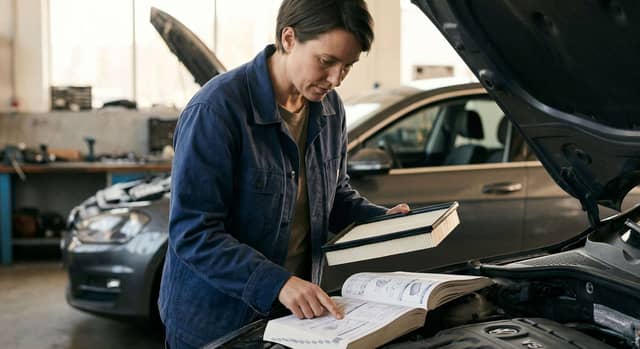

Buy car parts isn’t just about cost – suitability, availability and delivery times are all equally important.
Most drivers order car parts online the same way they shop for anything else: pick the model, find the cheapest listing, confirm the order. But this method does not guarantee that the part will fit. Knowing what to check before you click "buy" is the difference between a straightforward repair and a two-week delay.
Online car parts retail has grown significantly across the UK in recent years, and North Lancashire is no exception. With dealerships concentrated in Lancaster city centre and rural areas stretching toward Carnforth and Garstang, many local drivers now rely on delivery rather than making the trip. The question isn't whether to order online, it's how to do it without the common pitfalls.
AUTODOC has recently launched its marketplace model in the UK, making it the tenth European market to receive the format. According to an announcement by Dmitri Zadorojnii, CEO at AUTODOC SE, the platform generated over 190,000 orders and grew to 1.2 million listed items during 2025 across its existing European markets. The UK expansion integrates local professional sellers, which in practice means shorter delivery distances for many orders. For drivers in areas like Lancaster or Morecambe where next-day courier coverage can be inconsistent, that distinction is worth factoring into a purchasing decision.
Why the right model name still gives you the wrong part
A common question among drivers considering the platform for the first time is whether AUTODOC is any good for this kind of structured search and the process itself gives a clearer answer than any review.
Incorrect orders are far more common than most buyers realise. According to the Roland Berger Automotive Aftermarket Pulse 2024 report, the rate of incorrect orders and returns in auto parts e-commerce reaches 15–20% in the B2B segment and 5–7% in the consumer segment. For everyday drivers, that means roughly one in fifteen orders ends up being the wrong part.
The reason is almost always the same: selecting by make and model isn't precise enough. A 2017 Ford Focus, for example, can carry one of several engine variants, each requiring a different filter, sensor, or brake component. Cars imported from mainland Europe or Ireland, which are not uncommon in this region, may carry EU-spec parts that don't align with what a standard UK catalogue lists.
Galyna Stepanova, Head of Customer Feedback at AUTODOC, puts it plainly: "We don't simply react to mistakes – we target the root causes."
What a well-built search process actually looks like
The more structured the search, the lower the risk. On AUTODOC, the selection process runs through three steps: make, model, and then engine specification.
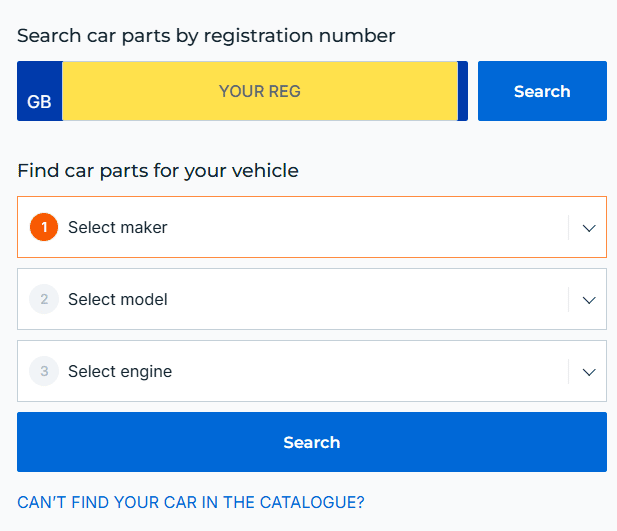
The search interface on autodoc.co.uk offers two routes: enter your registration plate directly, or work through make, model and engine step by step. The option "Can't find your car in the catalogue?" leads to specialist support.
That final step, engine type and displacement, is where most errors are avoided. A catalogue that stops at model level leaves too much room for the wrong result.
There is also a simpler route for those who find the filtering process confusing: searching by registration number. This is not the same as a VIN, it’s the standard number plate. The system uses it to identify the vehicle's exact specification automatically, without the driver needing to know engine codes or production variants.
Where neither method produces a definitive result, AUTODOC's support team offers manual part selection where a specialist checks the query directly. Each product listing also includes a photograph of the part itself, which allows a visual cross-check against the component being replaced.
The three-step filter is what the user sees. Behind it, the matching logic works differently to a standard keyword search. As Stepanova notes: "Our algorithms learn from past successful orders to suggest the most suitable part, not just the most popular one."
Five things to check before you confirm the order
Regardless of which platform you use, the same checks apply every time. For those wondering whether AUTODOC is reliable for cross-border or rural deliveries, the marketplace expansion and local seller integration are more important factors than star ratings alone.
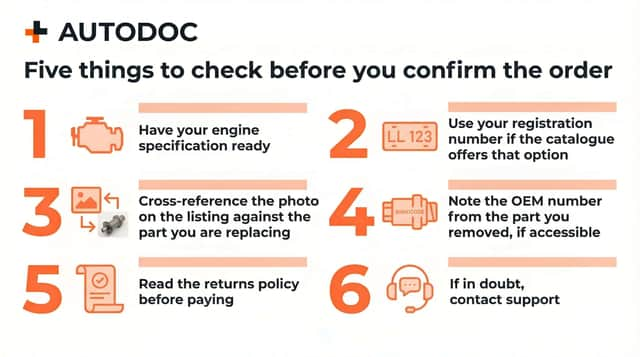
● Have your engine specification ready – not just the model name, but the displacement and fuel type
● Use your registration number if the catalogue offers that option. This removes guesswork
● Cross-reference the photo on the listing against the part you are replacing
● Note the OEM number from the part you removed, if accessible. It’s the most reliable match
● Read the returns policy before paying. On AUTODOC, incompatibility qualifies for a free replacement or full return within 14 days, but conditions vary between retailers
● If in doubt, contact support. A short query to a specialist takes less time than returning a wrong part
Online parts ordering works well when the selection process is treated with the same attention as the repair itself. The tools to get it right are available; the checklist above is a starting point for any driver, whether they are ordering from Lancaster or from a postcode further up the A6. Readers ordering on AUTODOC can apply promo code Q6X9P0MATD at checkout for a discount, valid until 31 May 2026.