
Death at Lancaster Castle prison linked for the first time to 1826 Lancashire mass hunger uprising
Recent archival research undertaken for The Open University has, for the first time, established a connection between the death of a prisoner in Lancaster Castle in 1827 and the 1826 Lancashire rising.


The uprising, which took place from April 23 to April 27, 1826, saw thousands of working-class people protesting across several towns in Pennine Lancashire including, Bury, Blackburn, Darwen, Accrington, Oswaldtwistle, Bacup, Haslingden, Helmshore, Edenfield and Chorley.
The dead prisoner, Thomas Leaver, had been arrested and prosecuted for breaking into the mill belonging to John Houghton, in the parish of Blackburn, on April 24, 1826.
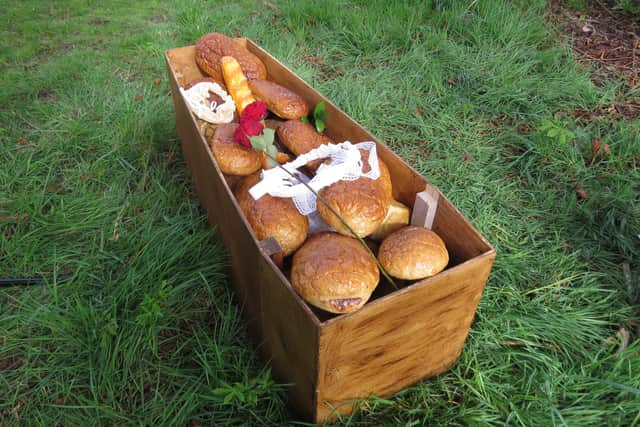
A large number of the Pennine Lancashire protestors were arrested during or shortly after the uprising and over 60 were later prosecuted at the August 1826 Lancaster Assizes. Some 42 protestors were convicted and originally given the death penalty, although all sentences were later commuted to either imprisonment or transportation.
In the summer of 1826, Lancaster Gaol was experiencing a mass health crisis. From the last week in August through to the first 20 days of September, more than 100 prisoners became seriously ill due to a “Cholera Morbus, Diarrhoea and Dysentery” epidemic in the prison.
Ten prisoners subsequently died. Amongst them was Thomas Ashworth, a 27-year-old carter from Rawtenstall, who had been charged with destroying machinery at the Whitehead brothers’ factory on April 26, 1826. Ashworth, who was serving a relatively short three-month prison sentence for his involvement in the uprising, died of dysentery on September 8.
The premature death of Thomas Ashworth has long been connected to the 1826 uprising. He was, for a long time, believed to be the only anti-starvation protestor to die in Lancaster Gaol.
In 2025, Open University research identified two other protestors, Simeon Wright and James Chambers, who respectively died on the Hulk Ship Dolphin in March and May 1827. Now the same researchers – Dr David Gordon Scott and Kate Hurst – have uncovered a further 1826 anti-starvation protestor death in custody – Thomas Leaver.
Thomas Leaver was a 26-year-old confectioner. Born on 19 May 1800 in Blackburn, he was the youngest of six children. His father James died early in 1807, and his 59-year-old mother Betty was buried three months before the uprising.
Leaver had been sentenced to be “severally imprisoned and kept to hard Labour in the Gaol of Lancaster Castle for eighteen Calendar Months” on September 8,1826, the very same day that Thomas Ashworth died of dysentery.
Prison conditions in 1826-7 were harsh and following the end of the Cholera epidemic the diets of prisoners at Lancaster were reduced.
The principle of ‘less eligibility’ ensured that the diets of those serving prison sentences were no better than those of the ordinary labourer living in the community, which, in times of mass hunger and starvation in the wider community, exerted even greater pressure on prison authorities to keep prisoner diets to a minimum.
Thomas Leaver served a year and 214 days, before dying of “atrophy” (i.e. muscle wasting and the effects of extreme hunger and starvation) at Lancaster Gaol on November 27, 1827. His remains were buried at Blackburn on December 2.
The Open University researchers commented that "the fact that it has taken nearly 200 years to publicly connect the death of Thomas Leaver to the uprising speaks volumes. The terrible irony is that Thomas Leaver died of a starvation related illness, the very same problem that he had so vigorously protested about back in April 1826.
"It is important that we remember all of those who highlighted the mass hunger the people of Lancashire were facing at that time.
"Thomas Leaver can now be remembered for his sacrifice alongside the other protestors who died because of the legal repression of the protestors, whether at the Chatterton Massacre, 26th April 1826 where soldiers indiscriminately killed six people or later in state custody."
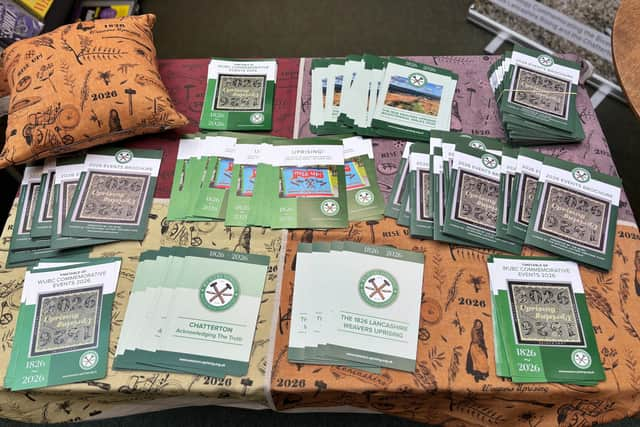
Commemorations of the 1826 weavers uprising will be taking place in Lancaster between August and October this year.
Towards the end of August, the Lancaster City Council ‘Uprising’ mobile exhibition will be on display at Lancaster Museum. During its residency there will be a talk at the Museum on September 2 by Dr David Scott and Kate Hurst, who will be discussing their research on the sentencing and punishment of the protestors.
There will also be a special day of commemoration at Lancaster Castle on October 10. This will include special musical performances, talks and a collaborative exhibition Rise Up / Lock Down! that highlights the artwork of Lancaster based textile artist James Fox and several other local artists.
The exhibition itself – on display in the old C Wing of the prison which was originally designed to hold women prisoners - will be open to the public in the first two weeks of October.