
Love it or hate it, the bridge was the city’s landmark project to celebrate the new millennium, although delays in its construction meant its opening was postponed until 2001.
Built to provide another access across this section of the River Lune for the first time in around 200 years, it has since been used by thousands of pedestrians and cyclists as well as opening up a new route for wheelchair users.
And it was an 11-year-old Lancaster schoolgirl who had the honour of being the very first cyclist to officially cross the new bridge on February 16 2001.
Louise Gibbons was a pupil at Our Lady’s RC High School, which could be accessed by the new bridge, and had won a cycle safety competition to have the privilege of officially crossing the bridge first.
Watched by hundreds of people, Louise said: “I’ve never had a proper big bike of my own before so it was bit scary riding over the bridge because I didn’t know how fast to go.”
But she did herself and her city proud after Olympic gold and silver medallist, Jason Queally, originally from Caton, pulled out of the ceremony owing to an injury.
However, Jason’s dad Tom did attend together with other family members and brought along the cyclist’s Olympic gold medal.
At the opening ceremony of the £2.3m bridge, the reaction was largely positive, especially among business owners on St George’s Quay.
Robert Mason of Simply French thought the bridge was ‘fantastic’ and would attract more people to the quayside while Ray Marshall, landlord of the George & Dragon, described it as ‘wonderful’ and of great benefit to Lancaster.
However, Three Mariners landlady Rhiannon Layton thought the bridge was an ‘eyesore’ and Quay resident Geoff Whitehead agreed: “The massive ‘v’ sign is an insult to Lancastrians. It towers over and breaks up the whole of the skyline. It is much higher than any other building in Lancaster and is appalling.”
The bridge designers, Whitby, Bird & Partners, were chosen following an architectural competition to find the best creative talent in the UK and although aware of the differing views about their work, were pleased with the end result.
Consultant architect Richard Johnson said it was difficult to imagine the area now without the bridge: “I hope that the people of Lancaster will adopt it, look after it and enjoy it.”
And Brian Alexander, one of the many welders who had worked on the bridge, spoke proudly of their achievement: “Every time I come past, I will look at it thinking, I helped to do that.”
The 114m curved deck of the bridge aimed to reflect the city’s maritime heritage with two 40m high angled vertical ‘masts’ and a leg of the bridge onto the quay echoed a gang plank, a common sight there in the 18th Century when Lancaster was a busy port.
It was constructed near the site of Lancaster’s ‘old’ bridge, first recorded in 1215, damaged by the Jacobites in 1715 and finally falling down in 1845. Some traces though still remain embedded in the mud.
Other crossing points of the river in Lancaster – Skerton, Greyhound and Carlisle Bridges – still stand though the new landmark was the largest element of the £4.5m River Lune Millennium Park project led by Lancaster City Council as part of the national celebrations to mark the year 2000.
Half of the funding was provided by the Millennium Commission with the remainder from a partnership including Lancashire County Council, the Environment Agency, North West Water, Lancashire Tourism Partnership, ERDF and others.
Most of the park was finished by the dawn of the new millennium and its progress was recorded by an exhibition at the Maritime Museum.
Running along an old railway line, the park stretched from Bull Beck at Caton to the quay and included new picnic sites, information panels and artworks.
Among the most controversial features were the Upside Down Trees ‘planted’ between the former Halton Station and Forge Weir and soon attacked with a chainsaw.
However, most survived until 2012 when they were felled for safety reasons.
Many of the other artworks though, still remain in the park including carved ‘pictures’ at Halton Station and Artle Beck with the one at Crook O’Lune featuring the late local councillor, Paul Woodruff, who ran a popular snack bar at the beauty spot.
Also standing the test of time is the Heron’s Head artwork, a nod to the range of birdlife which can be seen whether walking or cycling along the route.
And the stone carved lettering of ‘Lune’ by Lancaster’s Alan Ward can often still be viewed from the Millennium Bridge as can his setting of part of poet Thomas Gray’s description of a viewpoint now known as Gray’s Seat above the Crook O’Lune, once painted by JMW Turner.
“Every feature which constitutes a perfect landscape…is here not only boldly marked but in the best position”, wrote Gray.
Whether Gray would have waxed so lyrical about Lancaster’s Millennium Bridge is questionable but 25 years on it still stands proudly on the city skyline and to mark its anniversary children once again gathered there, to litter pick and plant bulbs along the route as part of improvements which will include new lighting, better seating, river bed cleaning and weeding.
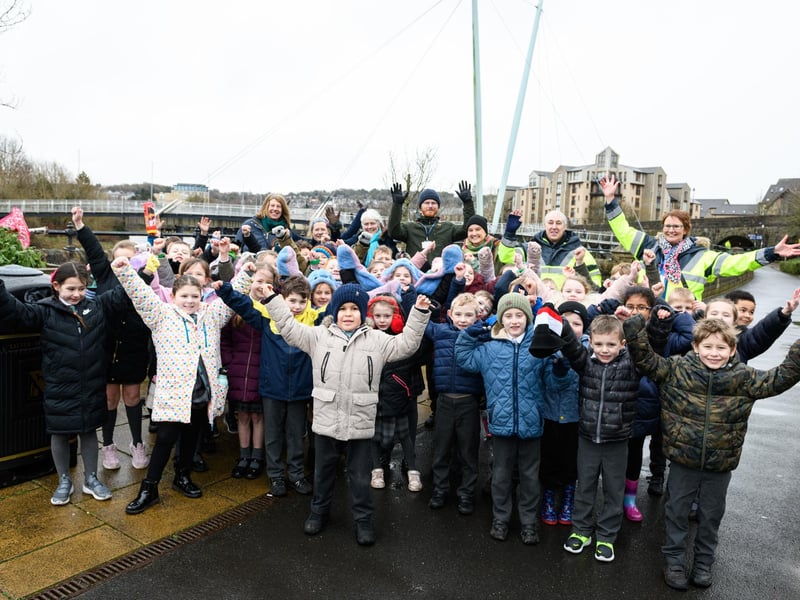
1. 25th anniversary of Millennium Bridge
Pupils from Grosvenor Park take part in the celebrations of the 25th anniversary of Millennium Bridge. Photo: Kelvin Lister-Stuttard
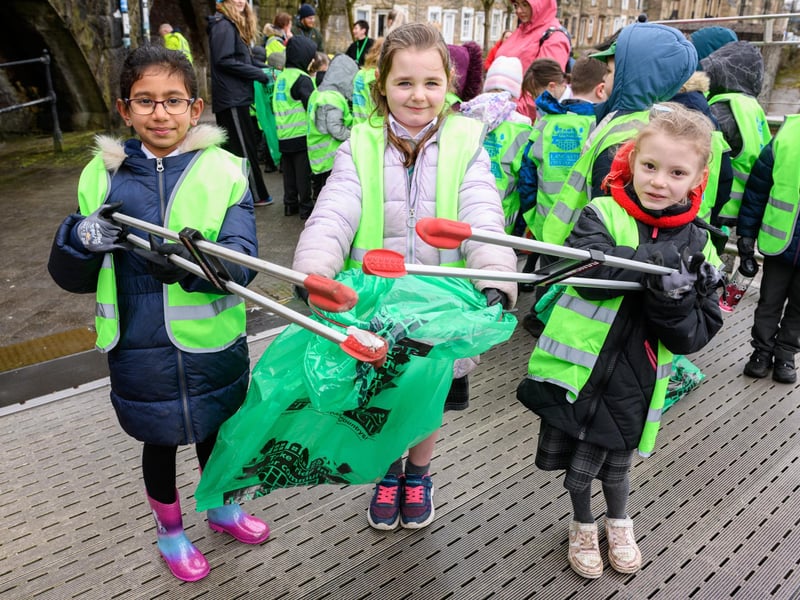
2. 25th anniversary of Millennium Bridge
Pupils from Grosvenor Park litter pick as part of the celebrations of the 25th anniversary of Millennium Bridge. Photo: Kelvin Lister-Stuttard
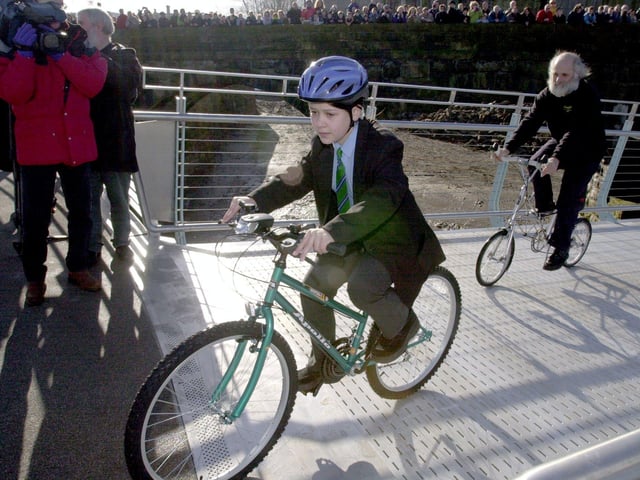
3. 25th anniversary of Millennium Bridge
Competition winner Louise Gibbons becomes the first person to cycle over the new bridge. Photo: Garth Hamer
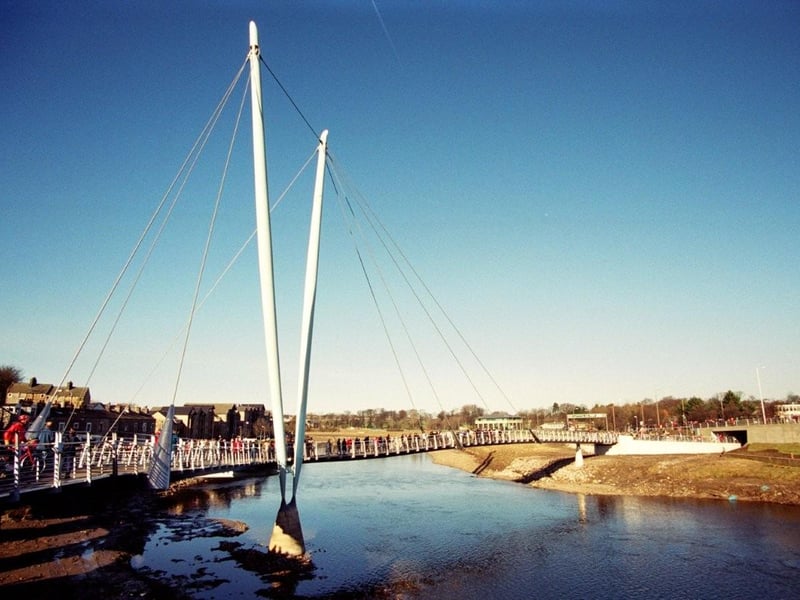
4. 25th anniversary of Millennium Bridge
Hundreds of walkers and cyclists took the chance to use the Millennium Bridge after its official opening in 2001. Photo: DJ Clark