
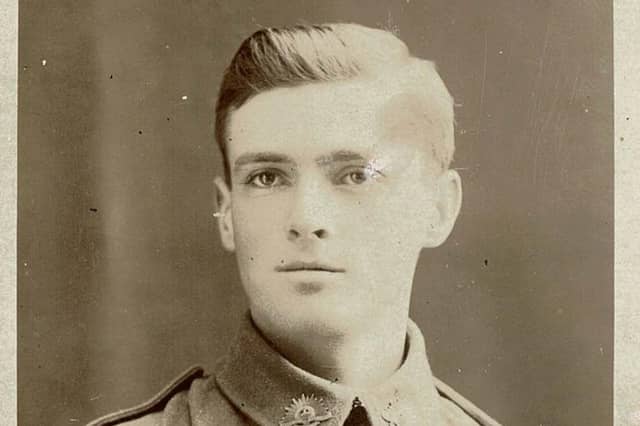

One of these is that of 18-year-old George Clifton Thexton.
George was born in Bairnsdale Victoria in June 1899.
In common with most Australian lads, he was a cadet for four years before joining the AIF (Australian Imperial Forces) in October 1917.
As he was underage for overseas deployment his father signed a waiver allowing him to go.
George was following in some illustrious family footsteps as he was one of 12 children, five of whom served in the AIF.
One of his brothers, William George, had enlisted but died of meningitis in May 1916 whilst embarking for overseas service at Fremantle.
Another brother, John Edward, was wounded in 1916 at the same time – and in the same battle – as his brother James Winwick who was killed on July 19 1916 at Fromelles in France.
Two other brothers, Percy and Charles also served.
George embarked for overseas service on HMAT Ulysses on December 22 1917, and apart from a few days in Egypt during January, sailed straight to England, he landed in Southampton from HMT Lassowe Castle on February 14 1918 being held on the strength of a training unit and later the 8/37th Battalion (8th reinforcement 37th Battalion), 10 Brigade, 3rd Division AIF.
However, he was taken ill in London on March 20 being sent to the King George Hospital. George was later transferred to Lancaster Fever hospital (from the Royal Lancaster Infirmary) on March 23, where he sadly died of Cerebro spinal fever on April 10 1918.
The Fever hospital was on the Quay next to Lune Mills.
He was buried with full military honours at 3pm on April 15.
A report was sent to his family about the funeral and stated that a funeral service was held in one of the cemetery chapels by Rev A R A Findlay, the vicar of St Thomas.
The undertakers were B J Richardson of Bulk Road.
At the funeral were his uncle and aunt, Mr and Mrs Lamb of Kendal and his cousin, Miss H Thexton of 4, Wingate Saul Road, Lancaster.
The coffin of polished Elm was surmounted by several beautiful wreaths and the firing party and Bugler were supplied by the Kings Own Regiment from Lancaster Barracks (presumably Bowerham Depot).
An Oak cross was erected to be replaced later by a Commonwealth war graves headstone, the personal inscription on the stone reads “For the Empire”.
George’s effects (including his wallet and personal items, badges, Bible etc.) were lost with the sinking of the SS Barunga, after it was hit by a torpedo from a German submarine 150 miles southwest of the Scilly Isles.
Barunga was on its way to Australia with 800 sick and wounded on board and was torpedoed at 4.30 pm on July 15 1918.
Destroyers which had been exercising some miles away were quickly on the scene to pick up survivors and return them to Plymouth.
All those on board were saved before Barunga sank.
George was awarded the British War Medal and later a commemorative letter, memorial plaque and scroll were sent to his family in 1922.
By this time the family had also lived in Auburn Road Auburn (where George’s picture was taken) and in 1918 were at Dalston road, Oakleigh, Victoria.
George is remembered on the honour board at Wy Yung- the place of his birth, and on the Australian War Memorial honour wall in Canberra.
Shaun said: “I would like to sincerely thank the Thexton family for the photos and additional information and the admin and members of the Gippsland History Facebook page.”
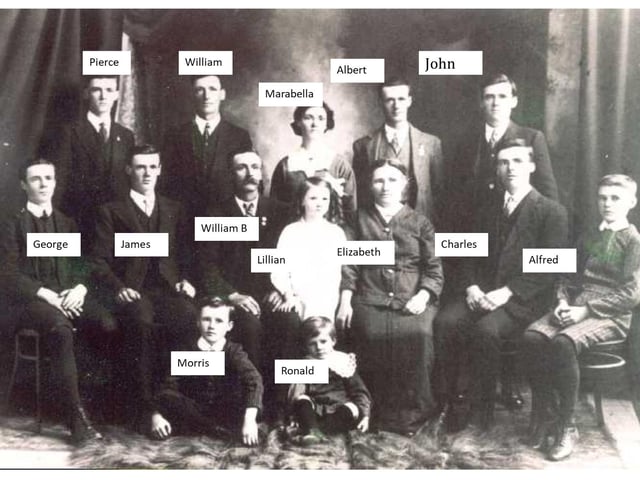
5. Sad tale of World War One Australian soldier buried in Lancaster cemetery
The Thexton family in 1914. Photo: Shaun Corkerry
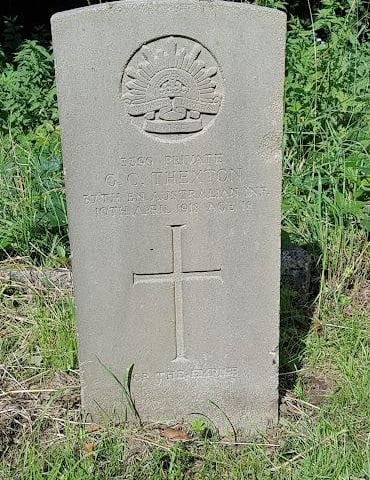
6. Sad tale of World War One Australian soldier buried in Lancaster cemetery
The grave of Pvt George Thexton AIF is in Lancaster cemetery. Photo: Shaun Corkerry