
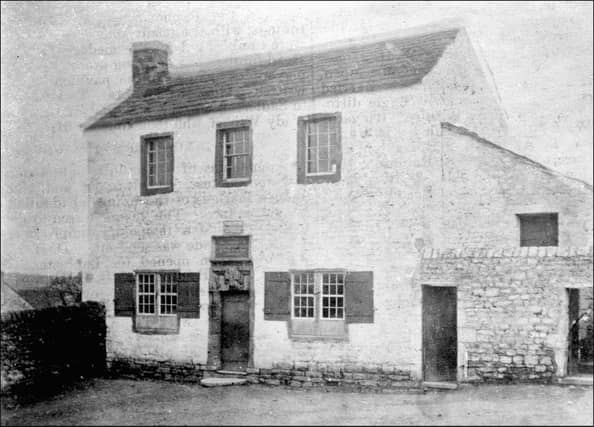

Wray man Richard Pooley who fought in the 17th century civil war under the command of Oliver Cromwell bequeathed £200 to establish a free school in the village, which was completed in 1684.
The sum was invested in a farm called Oaken Beck, near Low Bentham.
A further £200 was paid to the trustees and laid out upon land. The interest was to fund the teaching and education of children whose parents lived in Wray, Roeburndale and the lower end of Botton.
The school was completed in 1684 but by the 1880s was, unsurprisingly, in need of renovation.
The governors proposed a new school be erected in the gardens behind the old buildings.
The intention had been to retain the old walls but as work progressed this cost-saving measure was deemed unviable. Demolition was decided upon.
On May 1 1886 the new school was opened by Major Marten of Capernwray Hall.
Until 1914, Mr Smith was headmaster. His entries in the school logbook are full of references to poor attendance through sickness, wet weather, snow and haymaking.
The attendance officer was a frequent visitor. The medical officer called regularly and on a number of occasions the school was closed through, or to avoid, epidemics of colds, whooping cough, measles and diphtheria.
Another regular visitor was the drill Sergeant. One day the weather was too wet to go outside so the children did sitting drill and exercises at their desks.
Apart from physical exercise, gardening had been added to the curriculum. Mr Dodd was headmaster from 1914 and seems to have been fond of the school garden but, as one inspector reported, the ‘steep slope, heavy soil, northern aspect provide interesting problems.’
Empire Day was celebrated each May with a patriotic concert and sometimes a holiday.
The vicar gave an address on the ‘greatness of our empire’. Fourteen Empire Day medals were presented to the children for meritorious work in the essay competition.
Another special day was Shrove Tuesday which was the day of the annual fruit banquet. This event had been started by C L Reynolds, vicar of Wray, a staunch teetotaller, to counteract the drunken revelry of the cattle fair held in the village on this day.
There were also Christmas celebrations, Band of Hope concerts and holidays and celebrations for royal occasions. Mr Dodd writes about the Silver Jubilee celebrations on May 25 1935 ‘this was a wonderful day for the children, neatly attired and waving the flag, they demonstrated in true British fashion, their loyalty to their king and country.’
There was a church service, a procession, sports, free tea, fancy dress and the presentation of mugs. Mr. Dodd described it in the school logbook as ‘a memorable and happy
day.’ James Dodd was considered a good teacher and a strict one. He liked the children to be neat and clean and would inspect their clogs every morning. Any breach of school rules or
misbehaviour would be punished, often with two or three strokes of the cane.
Nature walks were a pleasanter part of school life. The children would collect leaves, flowers, blackberries, oak apples and draw and write about them.
World War One seemed to make little impact on school life. There are few references to it in the school logbook. In December 1915 the children had been provided with
wool to knit for the soldiers. In July 1916 a collection was made for the relief of Belgium. In 1917 Joan Bannerman arrived from London, ‘removed here in consequence of air raids.’
The explosion at the National Filling Factory in White Lund in October 1917 caused great disturbance, even as far away as Wray.
Mr. Dodd noted on October 2 that only twenty children were at school by 9.20am, ‘the majority having been up all night wandering about the roads.’
In 1931 the children of eleven years and over who did not attend the Grammar School in Lancaster were taken by taxi each day to Burton in Lonsdale school.
In 1932 there were forty-five children at Wray school.
The entry in the school logbook for September 1 1939 reads: ‘Outbreak of war. School closed.’ When it reopened on September 11 there were eighty-two children on the roll: thirty children from Salford had arrived without a teacher and the senior children who normally
attended Burton in Lonsdale had returned to Wray. On September 25 there were eighty-six children and only two teachers: sixty in the upper school with Mr. Dodd and twenty-six in the
infants. However, a temporary teacher arrived to help until a Salford teacher eventually turned up.
By January 1940, most of the Salford children had left. At the end of April Mr. Dodd retired after twenty-five years at the school.
Lucy Alice Swindlehurst took his place and became the first headmistress of the school. In October she married and became Mrs Bateson.
The children were issued with gasmasks and the windows in the infants’ room were wire-netted in case of air raids.
In January 1941 twenty children arrived from Salford with a teacher.
They remained for the duration of the war. A number of evacuees from Liverpool and London were also brought to Wray. During the war there was frequent changes of teachers, with most
staying a term or less.
For most of the evacuees, rural life must have been quite a shock. Most left their mothers behind and there must have been much homesickness at first.
Wray would have seemed quiet and dull; the children strange with their different experiences of life. But the people of Wray made them welcome. Most houses took in one or two children.
By the end of the wars some of the children were unhappy to leave and returned to visit in the following years.
There were concerts and competitions in aid of the war effort. In 1941 War Weapons Week was followed by Warships Week (1942), Wings for Victory (1943) and Salute the Soldiers
Week (1944). In January 1946 the school resumed as a junior school. In September there was a surprise treat when a gift of 24 lbs. of chocolate powder arrived from Canada. Each child
received 1⁄2 lb.
In the autumn the children collected rosehips to send to Scott and Turner in Newcastle and were paid three pence per pound. This continued for many years.
After World War Two attendance was no longer the problem it had been to Mr Smith at the beginning of the century.
Cars now fetched and returned children from the fells who no longer had to walk to school.
There were no longer absences on wet days, though they still managed a few extra days holiday each winter when they were snowed in.
With immunisation, epidemics were less likely with standards of health improving. In 1948 the first school dinners were served.
They were sent from a central kitchen in Hornby and cost 2s. per week.
Wray with Botton Endowed Primary School is still in the same building that was restored in 1885.
5. Memories of Wray school from its inception
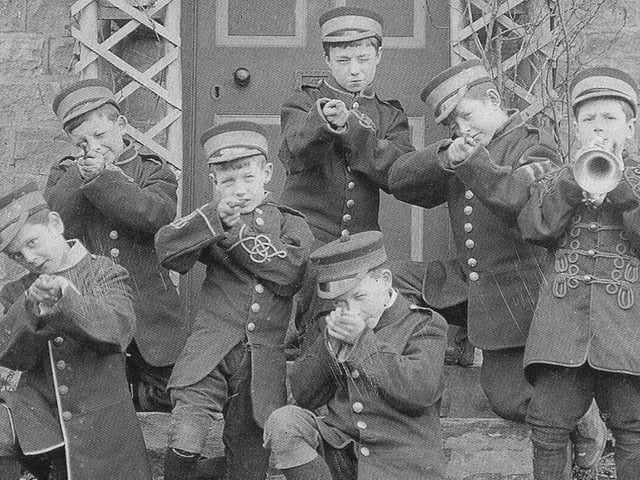
Dress rehearsals, school house, Wray. 1912. The children on the left have been rehearsing for the annual children's concert in connection with the Church Sunday School. Some sixty children took part on the evening of Saturday December 16. 1912. From left: Bob Walmsley, Harold Hargreaves, Norval Bargh, Archie Jones, Dick Grant, John Holroyd, Harry Chesters. Photo: David Kenyon. Photo: David Kenyon
6. Memories of Wray school from its inception
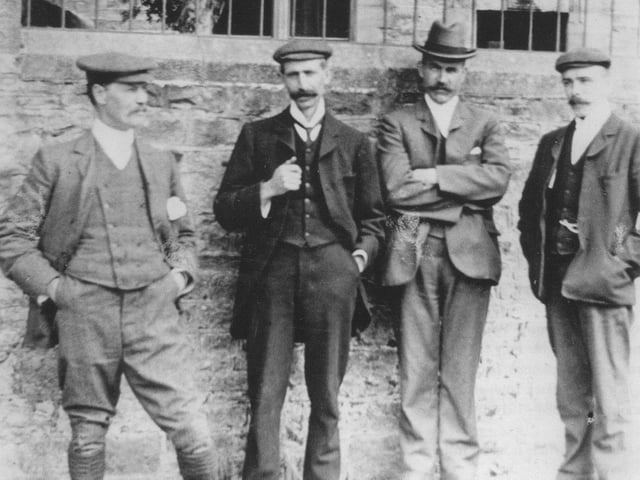
Local gentlemen, Wray Endowed School. From left: James Smith (headmaster 1884-1914). Thomas Taylor (postmaster of Wray 1904-6), Peter Grant (woodman of Hornby Castle, died 1924), William Birkett Dixon (owner of a woodturning business at Millhouses, near Wray, 1875-1946). Photo: David Kenyon Photo: David Kenyon
7. Memories of Wray school from its inception
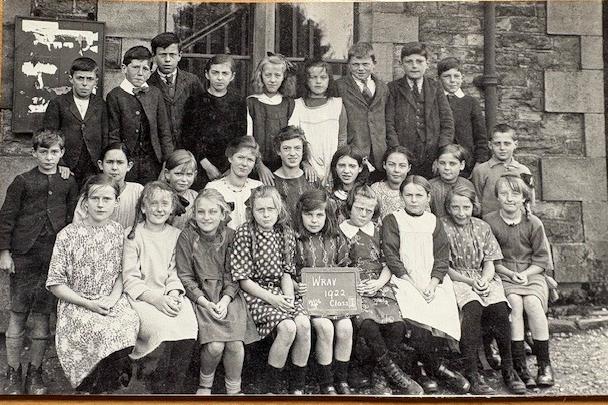
Wray school pupils, Class One, 1922. Back row from left: John Wilson, Francis Atkinson, John Singleton, Rene Townson, Peggy Kenyon, Ruth Woodhouse, Joe Woodhouse, Tom Askew, Reg Dixon. Middle row from left: Dick Kenyon, Grace Ridding, Ada Townson, Francis Townley, Alice Stephenson, Ruth Clarkson, Doris Roberts, Lily Hayton, Billy Hodgson. Front row from left: Agnes Kitchen, Mabel Taylor, Betty Askew, Eva Bevins, Dorothy Dixon, Mary Wilson, Olive Taylor, Mollie Woodhouse, Lucy Taylor. Photo: David Kenyon Photo: David Kenyon
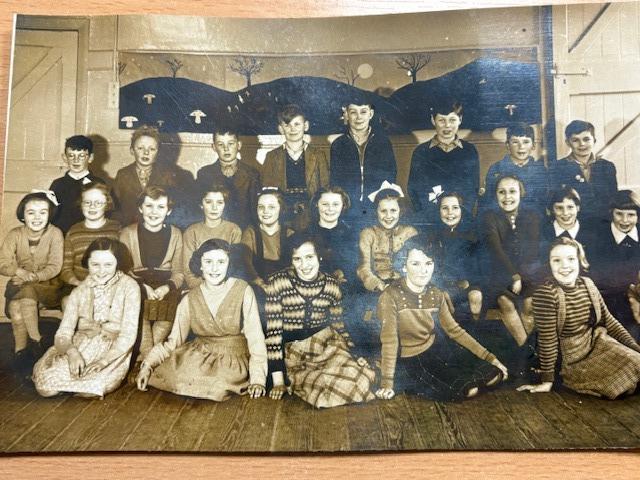
8. Memories of Wray school from its inception
Wray school senior class 1954. Back row from left: Jim Capstick, George Harrison, John Parkinson, Thomas Proctor, John Hartley, Ted Brown, John Capstick, Ronnie Kenyon. Middle row from left: Moira Hewitt, Joyce Woodhouse, Marilyn Dixon, Annie Hartley, Mary Lord, Kathleen Ibbetson, Joyce Bowman, June Wilson, Dorothy Conder, Pat Kenyon, Barbara Kenyon. Front row from left: Vera Walker, Mary Procter, Jane Mashiter, Sandra Costello, Elsie Harrison. Photo: David Kenyon Photo: David Kenyon