
Lancaster Uni regularly generating 100% of its own electricity for the first time
Lancaster University has taken a giant leap towards net zero.
Through a new solar farm, the university regularly generated 100% of its own electricity for the first time this spring.
Situated on Hazelrigg Lane, the 11 MW Solar Farm began producing energy late last year.
It was carefully installed with consideration for biodiversity and includes an important agrivoltaics field demonstrator, which will be used to explore how people might be able to use the same land for both solar electricity and agricultural production.
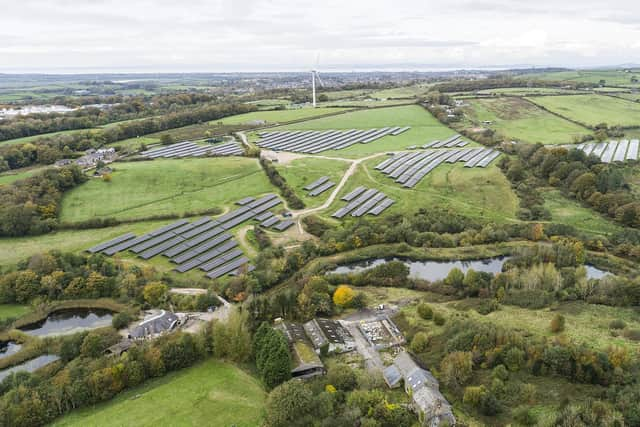

It will be the first of its kind in the UK and an important research, innovation and engagement facility for scientists, researchers and industry.
The solar farm is the latest in a series of ambitious clean energy milestones which have already halved campus energy-related emissions, opened research and teaching opportunities and effectively established a ‘living laboratory’ for low carbon energy transition.
The university has already slashed its energy-related carbon emissions from a peak of 25,900 tonnes CO2e in 2005 to 10,900 tonnes CO2e in 2025.
Together, the university’s wind turbine, new solar farm, heat pump array and an under construction expanded district heat network are expected to reduce energy emissions to net zero by 2030.
As well as implementing research-informed energy saving measures, the university has radically transformed the way it is powered and heated, thanks to a series of carbon-slashing investments.
Lancaster University Vice-Chancellor, Prof Steve Decent, said: “Taken together, these developments are enabling the university to become one of the UK’s HE sector’s largest producers of clean energy and to position itself as a hub for research, experimentation and a test bed for energy transition.”
Lancaster University Head of Estate Development (Project Delivery), Anna Cockman, added: “Lancaster University has made major strides towards net zero and established one of the largest clean energy ‘living laboratories’ of its kind in Europe.
"We are now in a unique position to become a national demonstrator for the transition to net zero. Policy makers, businesses, students, and researchers are already making use of these important facilities.”