
The official British government map states, in large red letters: ‘WARNING Access land and Public Rights of Way on Morecambe Bay are dangerous. Seek local guidance.’
This alone suggests that this is not a conventional drive.
Crossing Morecambe Bay, in the North-West of England, is a journey shaped by history, landscape and tradition.
The public right of way lies not on tarmac roads, but across open sands revealed only at low tide, where the boundary between land and sea is constantly shifting.
The key to making the crossing safely is the King’s Guide to the Sands.
The role dates back to 1548, when it was established to lead travellers safely across the bay.
Today, the main responsibility rests with Michael Wilson, the 26th in an unbroken line spanning nearly five centuries.
Ultimately answering to the British monarch, Wilson has to read a landscape that changes daily – identifying safe routes, avoiding quicksand and protecting the bay’s abundant wildlife – while judging tides that can return “at the speed of a cantering horse”.
It is a role of significant responsibility, though little financial reward.
The salary was raised to £15 per annum centuries ago, though it does include the use of a handsome stone-built house overlooking this stunning landscape.
“People have always crossed at low tide,” Wilson explains. “It used to cut as much as three days off their journeys, and there was a scheduled stagecoach service before the railway was built. Today, the official right of way is not defined to one particular route. The Monk’s Road, as it’s called, is actually the whole bay – wherever the Guide deems safe.
Michael Wilson said: “It can be very dangerous out there if you don’t know what you’re doing. There have been tragedies on the sands all through recorded history, and they sadly still happen when people venture out on their own. But I don’t think anyone has ever lost their life in 500 years when the King’s Guide was present.”
While the principle remains unchanged, the process has evolved. “Travellers once knocked on the Guide’s door to be told when to return,” he says. “Now it’s all done by email.”
Today, much of the role is charitable. “More than £800,000 was raised for national and regional charities through guided walks and horse rides last year. Being part of that is one of the best aspects of the job.”
“People have always crossed at low tide,” Wilson explains. “It used to cut as much as three days off their journeys, and there was a scheduled stagecoach service before the railway was built. Today, the official right of way is not defined to one particular route. The Monk’s Road, as it’s called, is actually the whole bay – wherever the Guide deems safe.
At low tide, 310 square kilometres of sand are exposed, along with plenty of hazards. Tides return quickly, river channels shift up to 30 metres in 24 hours, and heavy rain leaves behind treacherously soft sand. Features such as the Lune Deep – a submerged channel that plunges to as much as 70 m – add further complexity. It is a landscape that demands expert local knowledge.
With Wilson leading the way on the tractor that he uses for his day-to-day work as a fisherman, an electric Porsche sets out across the approximately 15 km of exposed seabed.
There are no defined tracks—only subtle changes in the sand indicating where it is safe to drive. The surface varies from firm, compacted sand to softer, more unpredictable areas, requiring careful progress.
The crossing is quietly steady rather than fast. Wilson roves ahead, checking conditions and adjusting the route as needed.
Channels are crossed at carefully chosen points, where the water is shallowest. Anywhere that risks disrupting the wildlife is strictly avoided.
As the journey continues, the sense of scale grows. The shoreline fades and the fells become more distant. It almost starts to feel more like a desert than the seabed.
The Macan remains quiet, allowing the sounds of the wind, water and birdlife to come through.
Timing remains critical. Areas that are dry will soon be submerged. In order to stop before an impassable bed of sinking sand and to avoid disturbing the wildlife, Wilson sticks to the plan and retraces our wheel tracks before the incoming tide erases them.
Reaching dry land again marks the end of a journey that brings together tradition and modern engineering.
Wilson continues a role that has existed for centuries, while the electric Macan shows how new technology can adapt to demanding environments.
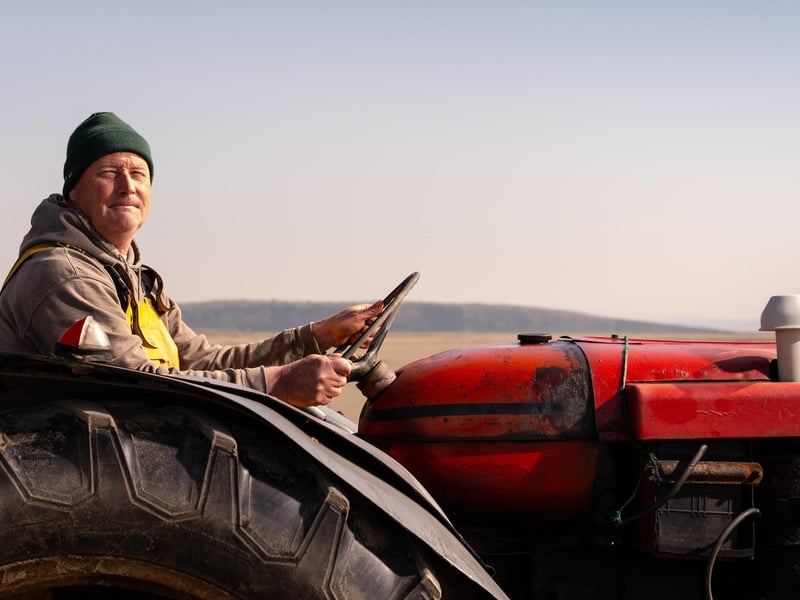
1. Electric Porsche crosses Morecambe Bay
King's Guide to the Sands Michael Wilson who guided the Porsche across a treacherous Morecambe Bay. Photo: Porsche
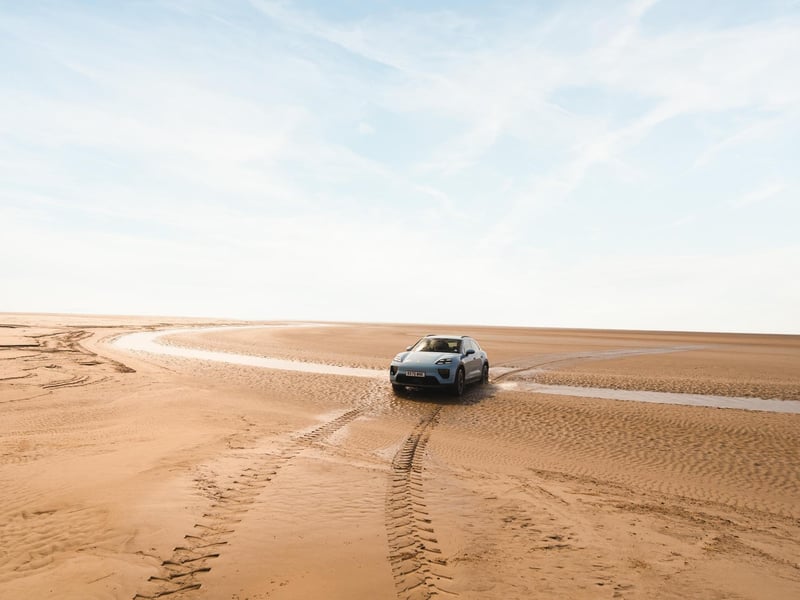
2. Electric Porsche crosses Morecambe Bay
An electric Porsche Macan which crossed Morecambe Bay. Photo: Porsche

3. Electric Porsche crosses Morecambe Bay
The electric Porsche Macan which crossed Morecambe Bay with the King's Guide to the Sands' tractor seen in the background. Photo: Porsche
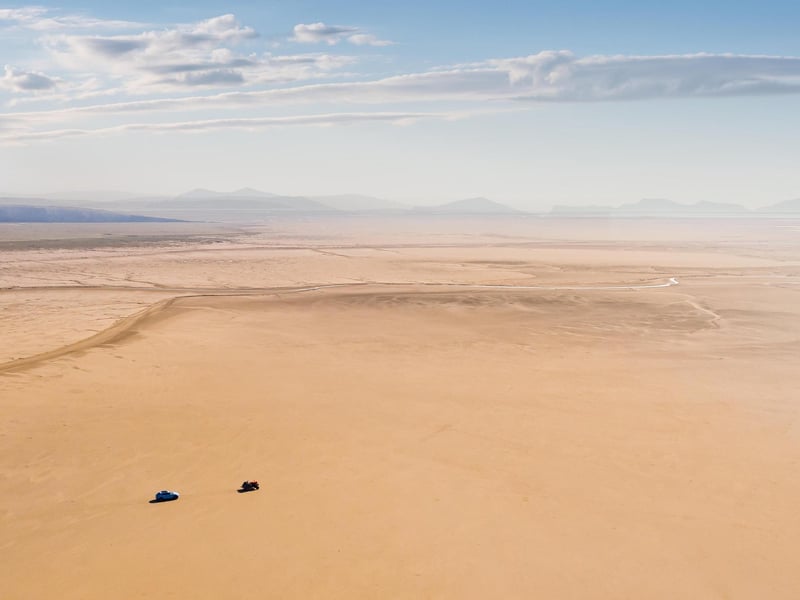
4. Electric Porsche crosses Morecambe Bay
An aerial shot of the Porsche Macan following the King's Guide to the Sands' tractor across Morecambe Bay. Photo: Porsche