
Former university students revisit historic Lancaster theatre where they had lectures after 60 years
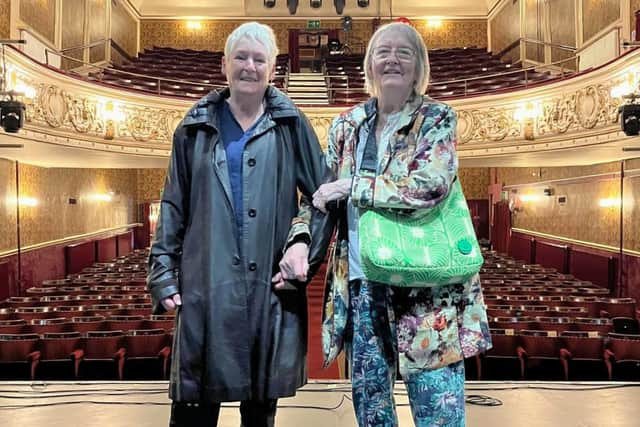
Two former students have returned to Lancaster Grand Theatre more than 60 years after they first sat in its auditorium for some of Lancaster University’s earliest English lectures.
The theatre welcomed a very special pair of visitors when Winifred Moran (née Evaskitas) and Sheila Northey (née Barry) returned to revisit memories of their time as students in Lancaster during the university’s earliest days.
Between 1964 and 1967, Lancaster Grand Theatre was used as a temporary lecture hall for the fledgling university, with students sitting in the historic auditorium and watching lectures delivered from the stage.
Winifred and Sheila were among those early students, attending around five or six lectures each week, with English among the subjects taught at the theatre.

It was a very different university from the Lancaster University we know today. At the time, there were only around 300 students, with a single library and just a handful of study rooms.
Teaching took place across a number of temporary locations, including the Waring and Gillows building, which had been adapted to provide classrooms and lecture spaces, as well as the Grand Theatre.
The university itself was still in its infancy. The idea of establishing a university in Lancaster had first been publicly endorsed in 1947, before Lancashire County Council revived the proposal in 1961 and established a Promotion Committee for a University in North-West Lancashire, chaired by Lord Derby.
For Winifred, her time as a student in Lancaster would also lead to a very important personal chapter in her life.
It was during this period that she met her future husband, Professor Michael Moran. The couple went on to marry when Winifred was just 21, before Professor Moran later became a lecturer at the University of Manchester.
At a time when only around two per cent of those attending the university’s lectures were women and from working-class backgrounds, Winifred and Sheila were part of a small but significant group of young women helping to establish university life in Lancaster.
They also played a role in setting up university societies during their time in the city.
Both Winifred and Sheila lived in bed and breakfast accommodations in Morecambe while studying, experiencing the beginnings of university life at a time when there was little of the
established campus infrastructure that students would recognise today.
More than six decades later, Winifred and Sheila independently got in touch with Lancaster Grand Theatre to arrange a return visit.
Their reason was simple: they wanted to stand once again in the theatre where they had spent so many hours as young students, and to relive memories of a time when this historic stage was being used for something very different from the performances it usually hosts.
Winifred added: “About two years ago, my son, Professor Joe Moran (Liverpool John Moores) gave a talk as part of the Lancaster University Public Lecture Series. It focused largely on the early years of the university including a mention of the Grand Theatre. This talk is still available online for anyone interested.”
For Lancaster Grand Theatre, their visit offered a fascinating opportunity to connect the theatre’s own history with the early story of Lancaster University.
Today, the Grand Theatre is recognised as one of the UK’s oldest working theatres, with a history stretching back to 1782.
But for a period in the 1960s, its auditorium became an unconventional university lecture hall, providing a place for some of Lancaster’s earliest students to gather, learn and begin what would become lifelong connections with the city.
For Winifred and Sheila, returning to the theatre was a chance to step back into that classroom once more, more than 60 years after they first took their seats.
And for the Grand Theatre, welcoming them back was a reminder that the history of a building is not just held in its walls, but in the memories of the people who have passed through its doors.