
School pupils help restore eroded saltmarsh near Lancaster
Year 9 students from Dallam School have taken part in a hands-on saltmarsh restoration project at Hest Bank, working alongside researchers from Lancaster University to help repair a stretch of coastline that has suffered significant erosion.
The project grew out of the school's involvement in the Morecambe Bay Curriculum and a partnership between Dallam geography teacher Becky Shanley and Dr Suzi Ilic of Lancaster University.
Together they developed a unit of work centred on one of the region's most important local environments, the salt marshes of Morecambe Bay.
In the classroom, students explored what saltmarsh is, why it matters, where it is found, why it is under threat, and how it can be restored. They then put that learning into practice by designing and creating their own nature-based solutions to help restore an eroded area of the saltmarsh.

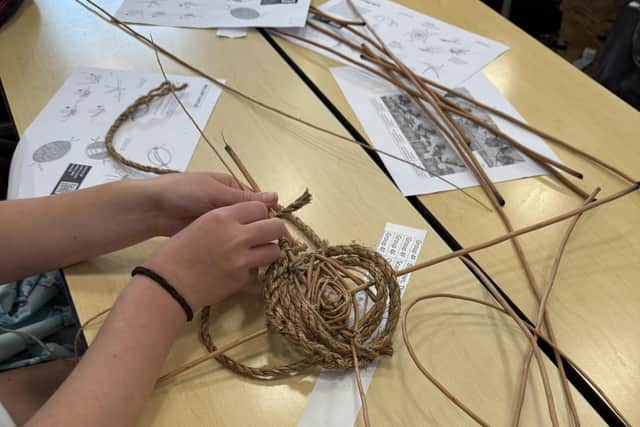
During an in-school workshop, students worked with Dr Ilic and a Lancaster University master's student to build sediment traps from natural materials, working through the practical challenges of designing and weaving their structures and adapting their ideas to the materials and time available. They then travelled to Hest Bank to deploy some of the structures they had built.
Saltmarsh plays a vital role in the Morecambe Bay ecosystem, helping to store carbon, filter pollutants, support wildlife and protect the coastline from erosion.
"The saltmarsh at Hest Bank has been heavily eroded over time.
Ms Shanley said: "The opportunity to work with Lancaster University and the Morecambe Bay Curriculum team has been invaluable. It has allowed our students to go beyond learning about geographical issues in theory and instead work alongside people who are actively tackling those challenges.
"That has made their learning more relevant, more empowering and more connected to the place where they live."
The Morecambe Bay Curriculum encourages young people to connect geographical knowledge with sustainability and real-world problem-solving.
It is also designed to help students feel they can make a difference in the face of environmental change, rather than simply learning about it in theory.
Students are now reflecting on the project back in the classroom, considering how the saltmarsh may continue to change over time, what further action could support its restoration, and how their work might be monitored in future.
Ms Shanley added: "This is the first time many of our students have been able to take part in an activity where they can revisit a site to see the positive impact they are having on the environment.
"A lot of fieldwork involves seeing, studying and measuring, but this time they have the chance to enact real change."